Over four Fridays, we will explore three sets from Cork and Kerry, then meet at the Third Friday Céilí to dance with live music. We will learn a few movements, put them into dances, and review familiar moves as they appear again. Come to enjoy the dancing. There is no need to study or practice between classes. Also each week if you would like to dance the set of the week to live music we will be dancing it at Steeplejack on Hawthornes Tuesdays at 6:30pm.
We will learn the figures that fit our time and our group. The lists below are references for anyone who wants to look back or explore further; you do not have to memorize them.
On each weekly page you will find video references and under the resource page you will find video and music playlists as well as more set dancing resouces.
Missing a class or forgetting a move is no problem. We will review as we dance. I have your back!
week 1
Week 1 — September 25 – Televara Set
County Kerry · We began with the polka step, moving in place and around the set, then practiced the swing, house around, and square the house. We found our places in the set and brought those movements into Televara. The set includes jigs, slides, and a reel.
Televara movement guide
The movements below listed in the order they appear in the dance. A move is listed when it first appears, so recurring moves are not repeated.
This week we’ll build on the polka step and partner movements from our first class, introducing Borlin’s quarterhouse and bringing the skills into the set.
6:30–7:10 — Skills
6:30–6:40 · Warm-up and review
Find the rhythm with the polka step, dancing in place and traveling. Briefly revisit the swing, house around, square the house, and home positions as needed.
6:40–6:55 · Quarterhouse
Introducing the quarterhouse: jump kick. Practice slowly with a partner, then try it with music. Offer a gentler heel-drop option for the jump.
6:55–7:10 · Movements for the first figure
Practice the crossed-hand lead around and follows chain. Bring the movements into half sets or full sets, reviewing familiar skills where they occur.
7:10–8:20 — Dance the Borlin Valley Polka Set
Begin with Figure 1 — Follows Chain, walking through the movements and then dancing with music.
Continue one figure at a time as the group is ready:
Figure 2 — Two Squares
Figure 3 — Advance and Retire
Figure 4 — Four Squares, danced to slide music, if time allows.
The hornpipe figure is optional.
If there is time: Revisit a familiar figure from the Televara Set.
The goal of this course is not to collect as many steps as possible.
The goal is to be able to dance.
Some of my favorite dancers have only a handful of steps. What makes their dancing compelling is not how many steps they know. It is how they use what they have, how they listen, and how they play with the music.
This week we begin with three pieces of vocabulary: 3 Shuffles, 2 Shuffles, and 4 Heels.
Intermediates you will have grapevine step & triplets.
These are building blocks, not a routine you have to reproduce.
One movement is enough to begin. A handful of movements can make a lot of dancing.
And one step is enough to begin.
Intermedates
week 2
Week 2 — Practice Counts
Practice does not have to be long, formal, or happen on a dance floor. Thirty seconds counts. One small piece counts. Coming back to it counts.
This week, beginners learn Cross Step and revisit 3 Shuffles, 2 Shuffles, and 4 Heels. Intermediates learn a cross step with extra beats and build on Grapevine and triplets, exploring direction, both sides, and connections to familiar movements.
Our focus is on making the movements more comfortable and finding our way from one to another.
Learn a Little Chunk
I once found myself practicing a tiny piece of a dance step in the cheese aisle at the grocery store. It helped change the way I thought about practice.
You can practice while the kettle boils, while waiting for something, or during a little pause in your day. You don’t always need music or a whole step.
To woodshed something means to take out one small piece, slow it down, repeat it, listen to it, and then put it back into the larger movement.
Where Is Your Weight?
When something feels tangled, ask:
Where is my weight? Where does it need to be?
Step: If you step it alows you to change your weight from one foot to the other.
Tap: If you tap it alows you to make a sound while keeping your weight the same.
Notice which foot is available for the next movement. Sometimes changing a step to a tap—or a tap to a step—opens up a connection.
Make the weight change obvious at first. You can make it smaller as it becomes familiar.
The Transition Game
Choose two movements. Dance the first into the second, then reverse the order.
For beginners, try Cross Step and one movement from Week 1. Intermediates can try Grapevine and something already in their feet.
If the connection feels sticky, practice just the end of the first movement and the beginning of the second. Then put them back together and try with music.
These are experiments. You don’t have to memorize a particular sequence.
Home base and Keep Dancing
Choose one comfortable movement as your Home Base. This is the step that is easies for you and that you can come back between playing with these steps. My dance teacher Mick calles this is banner step.
Put on a jig. Begin with your home base step and bring in another movement when you’re ready.
If you get lost, return to home base. Listen. Choose again.
You don’t have to use everything you know every time you dance.
Your Practice Menu
Choose one thing that helps today:
Practice one small piece for 30 seconds.
Revisit Cross Step or Grapevine.
Connect two movements.
Check your weight at a sticky connection or change weight in a step.
Listen to your feet without music.
Put on a jig and dance.
This is a menu, not a checklist.
What felt more comfortable this week? Where could a tiny moment of practice fit into your day?
week 3
Week 3 — There Isn’t One Right Way to Learn
1. Start Here
Different people learn in different ways. You may need to see something, hear it, copy it, stop watching it, slow it down, repeat it, understand the weight, or feel the whole thing first.
You may even need a different approach for different movements.
This week we add 8 Shuffles and begin treating our practice tools as a Learning Menu.
A restaurant menu gives you choices. It is not a checklist.
You would not go into a restaurant, look at the menu, and think: “I have to eat all of this.” You couldn’t. You’d make yourself unwell!
Our Learning Menu works the same way. Choose one thing that sounds useful. Try it. If it helps, stay with it. If it doesn’t, choose something else.
Then ask a new question: can the same or similar sound be made with a different movement?
Intermediates – run on and madness
What do my feet DO? What do my feet SOUND like?
Experiment with step, tap, shuffle, or weight change. Then return to The Black Rogue.
3. Practice: Choose How You Learn
If you are stuck, you do not always need to try the same thing harder. Change your approach.
Watch.
Listen.
Copy.
Stop watching.
Slow down.
Check your weight.
Step or Tap.
Take One Foot Away.
Use the metronome.
Take the music away.
Ask a question.
Leave It Alone.
Just Dance.
You do not have to use my menu. You might say the rhythm, write something down, use your hands, sleep on it, or invent another way that works for you.
Instead of “I can’t do this,” ask: “What else could I try?”
Leave It Alone
Leaving something alone is not the same as giving up.
Giving up says: “I can’t do this.”
Leaving it alone says: “My feet don’t have this yet. I’ll come back.”
Intermediate / Explore Further — Week 3
Use exactly the same concepts with more vocabulary: Step-Heel-Step, hips, Run On with Pause, triplets, weight changes, direction, and anything already in your feet.
Progression: Hear it → make it → repeat it → change it → remember what you did.
Warm-up & dance what you know — 10 minutes Play The Black Rogue. Start with familiar movements: 3 Shuffles, 2 Shuffles, 4 Heels, Cross Step, 8 Shuffles. Prompt: “What’s already in your feet?”
Check in & woodshed — 5 minutes What feels easier? What needs attention? Choose one small piece to practice.
Tip Step with Click — 15 minutes Demonstrate, break it down, and repeat. Take the click out to practice separately, then put it back. Cue: “Where is your weight? Step changes weight; tap keeps it where it is.”
Transition game — 10 minutes Home Base → Tip Step with Click → Home Base. Try connecting it to another familiar movement.
Three-step dance / partner practice — 10 minutes Choose Home Base, something you enjoy, and something you’re working on. Repeat, change the order, and make choices. Use breakouts online or pairs in person.
DANCE & reflect — 10 minutes Listen to Winnie Hayes, then dance using those three choices. Ask: “What do you want to focus on next?” Home practice: dance three times this week with one focus.
Intermediate additions: Explore making Tip Step with Click two-sided; deliberately choose whether to repeat or change sides. Try a drum in different jig rhythms.
Tonight’s reminder: “You’re already dancing. Three movements are enough.”
Week 4 Halfway Reflection / Practice
This is a midpoint observation, not a report card.
What was my original goal?
Where am I now?
What is easier?
What is still hard?
How do I learn best?
Which practice tools helped?
What do I want to focus on next?
Has my goal changed?
Minimum practice: dance three times this week and choose one focus.
This is the Connemara step. This version is the step version vs the hop version. Both versions are at the heart of Connemara sean-nós dancing and Connemara set dancing. It is a key component of the Connemara Set, island sets like Inis Oirr and Inis Meáin, and the Claddagh Set, which Seamus O Meoloid revived in Ráth Chairn, Meath.
Ráth Chairn, a village with a rich history, was founded in 1935 by 27 families from Connemara, with 11 more joining in 1937. These families brought with them vibrant traditions, including the Claudagh set. Known for its sean-nós dance heritage, Ráth Chairn was designated a Gaeltacht in 1967.
I had the privilege of attending a set dance workshop led by Seamus at the University of Limerick. Seamus was generous and an excellent teacher. If you get the chance to watch him dance, take a lesson, or chat with him, don’t miss it. His dancing style is delightful; he often starts with a smooth lead-in before transitioning to percussive dancing, almost as if testing the tune. He has a playful style reminiscent of the dancers from the late 1990s—a joyful, fun, and sometimes comic approach that I don’t see as often today. It’s the kind of dancing that makes you smile.
Below is a video that breaks down the step without music. We also offer practice videos with music to get you started on the Connemara step. Enjoy dancing!
Chose any or all steps from last term and dance it to a polka.
Chose any reel, jig or slide step and dancing it to a polka. Jigs and slides replace the 1234 sound with a reel rhythm or a 123 sound ilke the 123 step from week 1.
Playlist for kid’s class with polka songs and steps
week 5
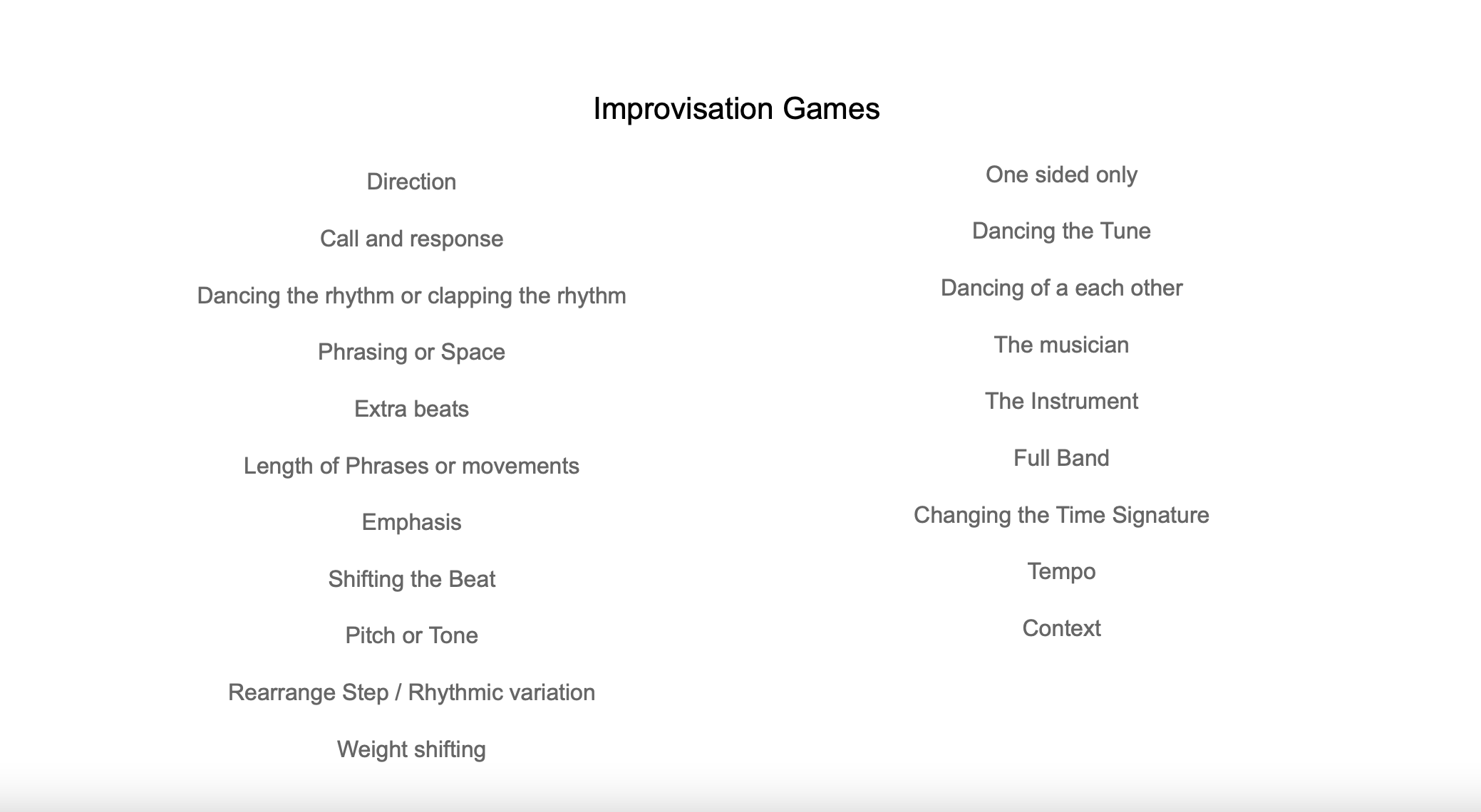
Improvisation!
There is no right or wrong here today. Improvisation is about play and playing with your steps and the music. Mistakes are not mistakes, keep going and exploring.
Full variation & creation list document – This is a google document. You can view it and if you want a copy or want to edit it save it to your google drive and you will be able to do anything you like to the document.
Double time reel step (shit step) – insert a movement
Insert a movement – insert a movement or a pattern into the original step. You might have to remove an equal amount of bars to make the step square or you can choose to leave them in and have a step that goes across the bars of music or something that you square off eventually.
Set Dance steps – Mapped, Half Mapped and Unmapped
You can also apply all of what we have learned over the last 6 weeks to your set dancing. Here’s the Cashel set if you would like to apply this to your set dancing.
Cashel Set – You could map what advance & retire step you might use for the Cashel set. There are other polka sets as well that you could do this with.
Mapped out
Here are a few mapped out options for you to explore.
Roisin Steps to Polkas – Mapped out
Stamp & Stamp
Heel & Stab
Cross Step
Circle Step
Zig Zag
Side Step (3)
Single Side step
Heel Toe Heel
Polka steps – Mapped out
123’s (with or without heel or tap extra beats)
1 & 2 & 123 (with or without heel or tap extra beats)
Side step (with or without heel or tap extra beats)
Mick’s Advance & Retire Step
Kick Up step
Any trick in polka time with 123’s as the timming step
Half Mapped
Alternate between happed and unmapped. Chose one step to keep going back to or map out a routine and leave everyother 8 bars open.
Unmapped
Unmapped. You can take everything you have learned and dance unmapped. Your steps can be unmapped but if you want some guide rails try picking a few improvisational tricks and dance with them in mind. In class we only danced one at a time as an exercise. The skys the limit. Pick as few or as many as you want to play with. Full variation & creation list document
week 8
Putting it all together!
Beginner
Intermediate
Advanced
Continue to work on your routines mapped or unmapped.
tunes
Music page – Membership music page. Here you will find many of the tunes on this site in one place. Each tune has a page with resources and downloads. Some tunes have a breakdown of the tune in a spreadsheet that you can use for writing and mapping out steps. If there is a tune that is not done yet and you would like to use it please let me know and I will create a breakdown for you. Over time my hope is to have a breakdown for each tune on the site to make it easy for you to create routines and choreography.
Variations – Taking any of these steps and shaping them into variations that suit your own feet and style might open up new possibilities. You might choose to simplify, embellish, or add elements from the master list. This kind of play can make the steps feel more comfortable and personal, helping you bring them naturally into your regular repertoire.
This spring, immerse yourself in Sean-nos reels! Our course caters to all levels and focuses on mastering Sean-nós dance while cultivating your unique style. Explore steps, improvise, choreograph, craft a performance piece, and enhance your stage presence. Join us for a dynamic dance experience.
This course is designed for all levels and is designed to grow with you as you grow as a dancer.