Blog

The Cheese Aisle That Taught Me How to Practice

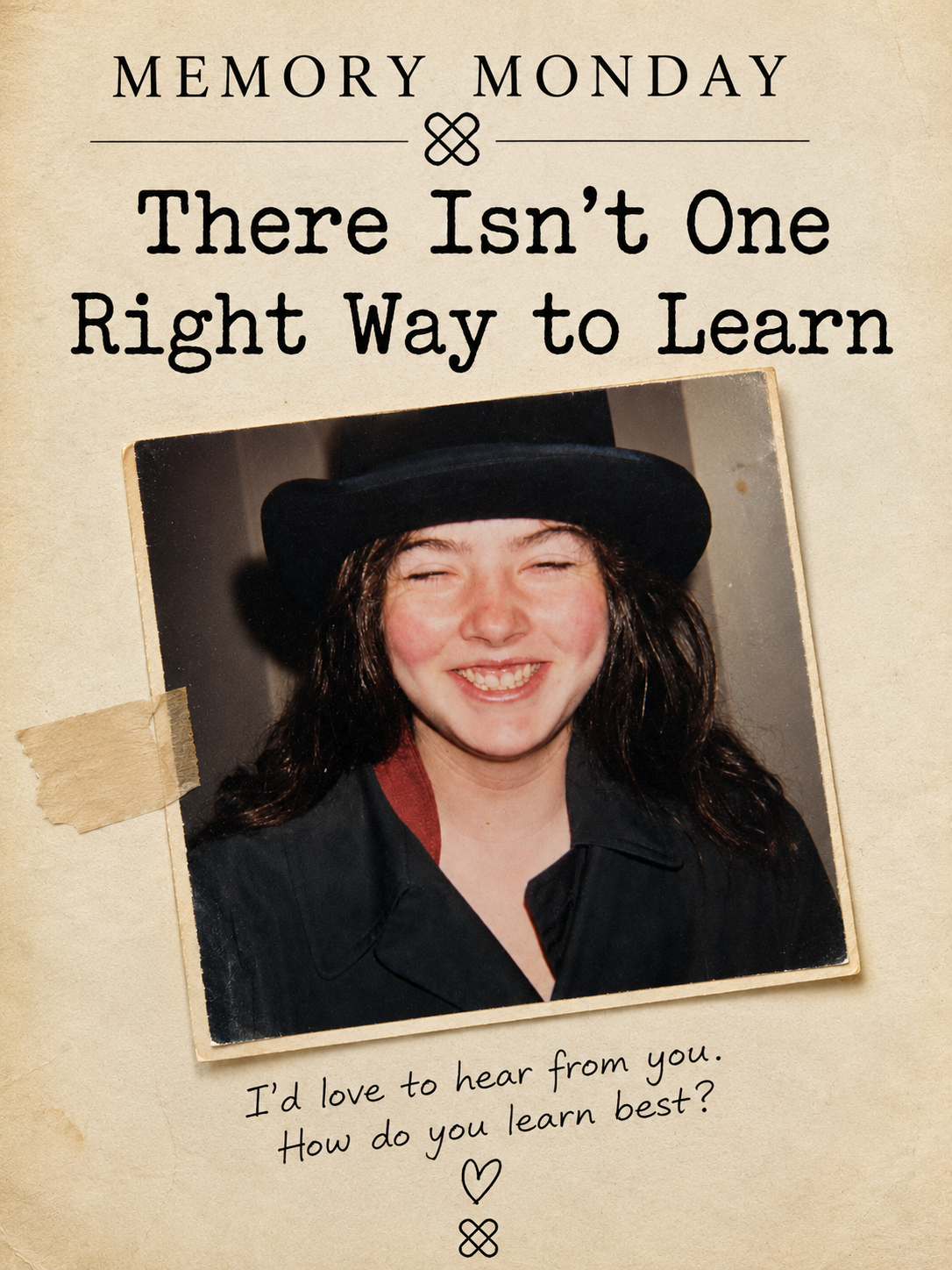
Memory Monday ◈

Memory Monday ◈

I Thought I Was Bad at Practicing

For years, I thought I was bad at practicing.

I didn’t have a regular practice routine.

I wasn’t setting aside an hour every day to work on my dancing.

And I felt guilty about it.

I put a lot of pressure on myself about what practice was supposed to look like.

Then one day, I was in a grocery store in Seattle with dancer Alicia Guinn.

I was standing in front of the cheese, trying to decide what to buy.

And while I was deciding…

I was dancing.

I didn’t even realize I was doing it.

Alicia came around the corner, saw me, and said,

“See! I’m not the only one who does that!”

I remember thinking:

Wait.

I’m practicing.

I just hadn’t been calling it practice.

That little moment in the cheese aisle changed the way I thought about practicing—and eventually, the way I taught it.

Practice doesn’t have to mean an hour in a studio.

It doesn’t have to require special clothes, a particular floor, or a carefully planned routine.

It can be five minutes.

It can be one step.

It can be listening to a tune.

It can be trying a rhythm while you’re waiting for the bus.

Or standing at the elevator.

Or waiting in line at the grocery store.

Your feet come everywhere with you.

So maybe the question isn’t:

“Did I practice today?”

Maybe it’s:

“Where could I dance for a few minutes today?”

That’s something I want my students—especially beginners—to know.

You don’t have to completely rearrange your life to become a dancer.

Start small.

Dance while you’re waiting for something.

Those few minutes count.

◈ ◈ ◈

I’d love to hear from you.

Where’s the funniest or most unexpected place you’ve ever found yourself dancing?

Or, if you’re just beginning:

Where could you dance for a few minutes today?

◈ ◈ ◈

This Week

I’d love to dance with you this week—online or here in Portland!

◈ Sean-nós Dance Classes

Monday & Wednesday

7:30 AM PT • 8:30 AM MT • 9:30 AM CT • 10:30 AM ET • 3:30 PM Ireland

Bring a YouTube clip of a musician or tune you’d like to work with, and we’ll develop steps to the recording.

I’ll guide you through the process while each dancer works with their own recording. There will also be time to share what you’re discovering and receive feedback.

Class information, Zoom links, recordings, and practice resources: https://maldonmeehan.com/2026-august-sean-nos-dance

◈ Open Studio Practice

Monday • Wednesday • Friday

8:30 AM PT • 9:30 AM MT • 10:30 AM CT • 11:30 AM ET • 4:30 PM Ireland

Need a little accountability? Join Open Studio hosted by Kathy Fletcher—a welcoming space to practice, ask questions, or simply spend time dancing alongside others.

And this week especially:

Remember that even a few minutes count.

Open Studio Details: https://maldonmeehan.com/open-studio

◈ Around Portland

Tuesday, August 18 — Steeplejack Set Dancing

6:30 PM

Join us for an evening of Irish set dancing with live music. No partner or experience needed—we’ll teach every dance.

Music: Eddie Parente & Cary Novotny

Dance List

  • South Galway
  • Cavan Reel Set
  • Cashel Set
  • Merchant

More Information: https://maldonmeehan.com/event/tuesday-steeplejack-ceili

◈ Friday, August 21 — Third Friday Céilí: Lúnasa

7:00 PM

Music: Betsy Branch

Waverly United Church of Christ
3300 SE Woodward St
Portland, OR

Dance list available on the website.

Details: https://maldonmeehan.com/event/3rd-friday-ceili-9

◈ ◈ ◈

Until next Monday…

Keep listening.

Keep dancing.

Keep the music alive.

— Maldon

Blog

The Two Words That Changed My Life

I still remember my first céilí.

I was nervous.

Really nervous.

The last dance I’d been to was in middle school, and I remember feeling like a wallflower. Later, in ninth grade, I wanted to go to another dance. I asked someone if they’d go with me, and they said no. So I never went.

Walking into my first Irish céilí, all of those feelings came rushing back.

But this time was different.

Mary Lowes smiled and simply said,

“Join us.”

Those two words changed everything.

I had no idea what I was doing.

I went the wrong direction.

I counted my 3s and 7s instead of listening to the music.

And somehow…

I danced the Fairy Reel and the Three-Hand Hornpipe with my dad and Mary.

I danced the Haymakers Jig with John, one of the Lewis & Clark students.

I remember thinking,

“I feel so grown up.”

During the break, one of the musicians, Tríona Ní Dhomhnaill, sang. Everyone sat on the floor and listened together. I’d never seen a room full of adults do that before. It was beautiful.

There was even a raffle.

On the drive home, I couldn’t stop talking about the music.

My dad smiled and said,

“Wait until you hear the albums I have at home.”

Albums?

The musicians I’d just danced to had albums?

We got home after midnight and put on a Bothy Band record. I stayed up listening until the early hours of the morning.

When I woke up the next day, I only had one question:

“When is the next céilí?”

Looking back now, I realize that evening wasn’t really about learning the Fairy Reel or the Three-Hand Hornpipe.

It was about someone making space for me.

Someone saying,

“Join us.”

More than 35 years later, that’s still why I teach.

I want to be that person for someone else.

Because sometimes all it takes is one welcoming evening…

and two simple words.

“Join us.” ❤️

◈ ◈ ◈

I’d love to hear from you.

What was your first experience with Irish music or dance?

◈ ◈ ◈

Classes, Current Classes, Irish Sean-nós Dance

2026 August Sean-nós Dance

overview

  • Dancing to different instruments: Fiddle, Pipes, Accordion, Concertina, Flute,
  • Youtube Video Playlist
    • If you find videos that you like you can add them here.

Week by Week

MondaysWednesdays
Week 13
Play with a varity of videos and instruments.
5
Work independently on a video of your choice.
Week 210
Contuinue to work on your videos.
12
Contuinue to work on your videos.
Find the same tune by another musician or instrument.
Week 31719
Patti teaching her stepsKeep Her Lit – Tolka Polka
Week 42426
Week 531

Keep Her Lit/Endurance

week 1

Week 1

Monday: Dancing the Tune: Listening to the Musician

Throughout this month, we’re using video recordings of musicians and different instruments to explore how the musician can guide our dancing.

Watch how each musician creates the music. For example:

  • Follow the movement of the fiddle bow and fingers, and translate those movements and sounds into your dancing.
  • Watch the piper’s hands on the regulators and chanter, and listen to what the drones add.
  • Notice the rhythm, phrasing, ornamentation, lift, and energy each instrument offers.

I’ve created a YouTube playlist for the whole month. If you find a video that inspires you, please add it to the playlist.

Playlists

Wednesday:

Homework for Wednesday

Find a video featuring a tune, musician, or instrument that inspires you to dance—something you’d like to explore—and bring it to class on Wednesday.

We’ll work individually with our own selections and then come together as a group to explore what each tune, musician, and instrument brings to our dancing.

A Helpful Tip

If you’re working with a whole set of tunes, or you want to jump directly to a particular moment in the video, save the link at the exact timestamp you want.

On YouTube:

  1. Go to the moment you want.
  2. Click Share.
  3. Check the box that says “Start at.”
  4. Copy that link and save it in your document.

That way, in class you can go directly to the B part, a particular tune, a musician’s phrase, or whatever moment you want to explore.

What Everyone Is Exploring

Here are the tunes and musicians everyone is working with. I’ve also added them to the full playlist in case you’d like to explore each other’s selections.

You are all wonderful dancers, and you’ve chosen some really interesting music to dance to! Each of you chose your music for different reasons, and I think we can learn a lot from one another by exploring what the others are hearing, seeing, and responding to.

I learn so much when someone sends me a musician or tune they’re listening to—it often makes me hear or see something I hadn’t noticed before.

Edith

Niall & Cillian Vallely

  • 1st of August — more views of the concertina.
  • 1st of August — try working off what the backing musicians are doing. Watch the body of the concertina player, too. I kept this link in here as I love what all the backing musicians are doing!
  • Muireann’s Jig

Cormac Begley

Nathan Gourley & Laura Fedderson

Patti

The Maid of Selma

Listen to Shannon’s breathing and notice the space she creates when she takes a breath. Katrina asked a great question: Can you dance in the space? Absolutely! My instinct when working with a wind instrument or a singer is often to leave that space—to let the breath be part of the dance. But that’s only one choice. You can also dance through the space, play with it, fill it, or respond to it in another way entirely. There are so many ways to dance to traditional music. That’s exactly what we’re exploring!

Sheila

Martin Hayes

Step-by-step teaching. Great for breaking down the tune and learning it in your feet. Sheila spent a lot of time just listening to the music. This is such a great way to learn a tune: get it in your ears before you put it on your instrument—or, for us, into our feet. As rhythmic backers, we’re creating our own backing for the tune. It may take us even longer than a melody player to really learn the tune, hear what’s happening inside it, and discover what we want to dance within it and create something or improvise.

Beth

Reel Set: Brenda Stubbert’s / The Ale Is Dear / Barrowburn

Beth has a whole set of tunes, so the timestamp trick will be especially helpful here.

There are some very cool variations and rhythmic patterns happening throughout these tunes. It could be really fun to explore all three and notice how your dancing changes from tune to tune.

These patterns may show up in other tunes, too, and by exploring them here, you’ll have more rhythmic options in your wheelhouse. It might also be really interesting to take some of these rhythmic patterns and try them with completely different tunes. How do they land? Do they still work? Do they make you hear or dance the tune differently?

Katrina

Martin, Roberts, Compton & Jordan

Watch the musicians’ fingers and see how you might use their movements to inspire steps, rhythms, or movements in your own feet.

Katrina has worked with this tune before. I love returning to tunes I already know because each time I come back, I discover something I didn’t hear or see before.

Sometimes knowing a tune really well gives us even more freedom to explore. We don’t have to concentrate as much on learning the tune, so we can pay attention to other things happening in the music—or notice what the tune brings out in our dancing.

week 2

Week 2

Monday: Continuing to Dance the Tune

This week, we continued working with the tunes and musicians everyone chose during Week 1. We are listening more deeply, noticing what is happening within the music, and allowing our dancing to grow from what we hear.

There Is No Wrong Here

I noticed that almost everyone began sharing their work by telling us what was wrong with it, what wasn’t finished, or what they didn’t like.

I want to encourage all of us to notice that habit.

I have been studying life coaching, and one of the things I want to bring into our classes is helping you develop confidence in your own dancing and creative work.

There is no wrong here.

As sean-nós dancers, we are playing—or backing—the tune with our feet. There is so much freedom in that.

Traditionally, sean-nós dancing was often learned informally. People watched, listened, copied, experimented, and found their own way of responding to the music. Steps were shared and borrowed, but the dancing was not about reproducing one prescribed piece of choreography exactly.

That freedom is still available to us.

A movement might feel wonderful with one tune and completely different with another. You might leave space, dance through the space, follow the melody, answer the musician, create a steady rhythm underneath the tune, or move across the musical phrases. These are all choices—not mistakes.

When you share your work, try beginning with:

  • “Here is what I’ve been exploring.”
  • “Here is something I discovered.”
  • “I really like what happens here.”
  • “This part is still changing.”
  • “I’m curious about where this might go.”
  • “I’d like some help exploring this section.”

You do not have to apologize for work that is still developing. Exploring, changing, and experimenting is the work.

What Everyone Is Exploring

Beth — Barrowburn

Beth has narrowed her focus to Barrowburn and is working with simple steps, including Róisín’s Connemara steps, while adding her own variations.

Set is dancing it at 80% speed. In the A part, Beth has a lovely upward movement with her heel that makes me so happy every time I see it!

During the second time through the A part, there are also some beautiful long bow sounds that could be fun to explore. Beth might lengthen a movement, allow something to stretch, or discover another way for her feet to respond to those sustained sounds.

The B part contains some busier sounds, and Beth is dancing some lovely “grinds” there. The contrast between the long sounds in the A part and the busier rhythms of the B part gives her many possibilities to play with.

Katrina — Tie the Ribbon / Lafferty’s and Trip to Sligo

Katrina’s steps for the A part are set, and it is so lovely. I love how she dances them again when the A part comes around. They fit so well. 

In the B part she has space and more variations. 

Katrina is also working with Trip to Sligo

Edith — 1st of August (I think this is still the tune she is working from last week, but I didn’t confirm)

Edith is practicing steps she wants to develop.

She is also experimenting with dancing across the bars rather than always keeping a step contained neatly within one musical phrase or following the tune exactly. This creates a lovely feeling of movement and continuity.

It is exciting to see Edith use the tune as a place to strengthen familiar material while also exploring a different relationship to the musical structure.

Patti — The Maid of Selma

Patti’s piece to The Maid of Selma. She is dancing it at 90% speed. 

She has been listening closely to Shannon’s breathing, varations and to the spaces created within the music. Patti can continue deciding when she wants to honor that space, dance through it, fill it, or allow her own movement to breathe with the music.

We also talked about sharing the finished piece with Shannon. It would be wonderful for her to see how her playing inspired Patti’s dancing.

Maldon — Ger Commane’s Reel

I am working with Ger Commane’s reel and exploring how my feet can respond to the tune.

I am doing the same work I am asking each of you to do: listening, experimenting, trying ideas, changing them, and allowing the dance to develop over time.

My work does not begin as a finished dance, either. I discover it by spending time with the music. As you know I can not dance right now so I am doing all of this with my hands and voice to create the sounds I am hearing. I have one phrase in the a part where I want it and am still listening the the whole tune. I sepnd an hour to get to that far. Be pacient with yourself creation takes time. 

As You Continue This Week

Keep working with your chosen tune or video. You do not need to finish or perfect anything.

Instead, notice:

  • What part of your dancing already feels good?
  • Where do you feel connected to the musician?
  • Are you following the melody, the rhythm, the movement of the musician, or something else?
  • Where might you leave space?
  • Where might you dance across a musical phrase?
  • What happens when you repeat a simple step and allow the tune to change it?
  • Is there one moment you want to explore in several different ways?

Most importantly, begin by noticing what is working.

You are not trying to find the one correct dance hidden inside the tune. You are building a relationship with the music and discovering how you want to dance with it.nt to dance with it.e building a relationship with the music and discovering how you want to dance with it.

Wednesday: Continuing to Dance the Tune

Patti — The Maid of Selma

Patti is dancing The Maid of Selma at 90% speed.

I love the strong pulse she creates with the run-on step. She also dances a variation the second time through the A part, which gives it a lovely sense of development.

Patti has been listening closely to Shannon’s playing and responding to Shannon’s variations. So cool!

In the B part, Patti is exploring some very cool offbeat steps and double toes.

Katrina — Trip to Sligo

Katrina is continuing to practice her reel and is also working with The Chieftains’ recording of Trip to Sligo.

She is exploring a grapevine step and Kieran’s jig step. Here are a few additional options from the website that she—or anyone else—might enjoy playing with:

The Coatroom Jigs include the step-shuffle-and-bang pattern that Katrina says is so satisfying! There are lots of options here to play with and try against the tune.

week 3

Week 3

Monday: Teach Your Step to Each Other

Working in Pairs

This week, we will work in pairs in breakout rooms and take turns teaching our steps to each other.

Teaching is one of the final stages of learning or creating a step. When you teach a step to someone else, you discover more details about it. You have to slow it down, understand the weight changes, and figure out exactly what your feet are doing.

The secret to improving my dancing—and creating cleaner sounds—has been teaching. Teaching has allowed me to practice steps for much longer than I might have practiced them on my own. It also helps me understand exactly what is happening inside a step.

Dancing slowly helps us discover things, just as dancing quickly helps us discover different things.

There is a philosophy of learning:

Learn one. Do one. Teach one.

This week, I want each of us to learn someone else’s step. Through this process, both the teacher and the student will discover new things.

The teacher may:

  • Notice details they hadn’t recognized before.
  • Develop a clearer understanding of the weight changes.
  • Find words, sounds, or movements that help explain the step.
  • Discover places where the rhythm or movement could be clearer.
  • See another possibility for the step through the student’s interpretation.

The student will have an opportunity to:

  • Discover someone else’s step.
  • Hear the tune through another dancer’s ears.
  • Explore a new rhythm or movement.
  • Notice how the step feels in their own body.
  • Bring their own voice to the step.

Each of you is doing very cool work and finding your own ways of responding to the tunes. Teaching your step to another dancer is one more way to deepen that connection—to the step, the music, and one another.

Remember: you do not need to teach your step perfectly. Your partner does not need to reproduce it perfectly, either. We are exploring together.

In Your Breakout Room

Each person will have a turn as both teacher and student.

When you are the teacher:

  1. Dance or demonstrate your step.
  2. Share what you hear in the music.
  3. Slow the step down.
  4. Break it into smaller pieces.
  5. Identify the weight changes.
  6. Help your partner put the pieces together.
  7. Try dancing it with the music.

When you are the student:

  1. Watch and listen.
  2. Ask questions.
  3. Try the step slowly.
  4. Notice how it feels in your body.
  5. Try it with the music.
  6. Share what you discovered.

Most importantly, be patient and curious with yourselves and each other. This is not a test. It is another way for us to listen, explore, and dance the tune together.

Patti Teaching her steps

The Maid of Selma – Shannon Heaton

Patti – please correct me if I’m wrong on any of this. PDF file with Patti’s notes.

AB
Part A1:
Step (L) shuffle (R), step (R) shuffle (L)
Step (L) heel-down (R) step (L) shuffle (R) Step (R) heel-down (L) step (R) shuffle (L) Step (L) heel-down (R) step (L) shuffle (R)
Step (R) shuffle (L), step (L) shuffle (R)
Step (R) heel-down (L) step (R) shuffle (L)
Step (L) shuffle (R), step (R) shuffle (L)
Heel (L), heel (R), heel (L), heel (R)

Part A2:
Step (L) shuffle (R), step (R) shuffle (L)Step (L) shuffle (R), step (R) Step (L) shuffle (R), step (R)Step (L) shuffle (R), step (R) shuffle (L)Step (L) heel-down (R) step (L) shuffle (R) Step (R) heel-down (L) step (R) shuffle (L)Step (L) shuffle (R), step (R) shuffle (L) Heel (L), heel (R), heel (L), heel (R)
Part B:
Slide together (extend L out, follow with R)
Heel-toe-down (L) heel-toe-down (R) heel-toe-down (L)
(ie: 3 hips)
Heel-down (R) heel-down (L) Heel-toe-down (R) heel-toe-down (L)
(ie: 2 hips)
Heel-down (R) heel-down (L) Heel-toe-down (R) heel-toe-down (L)
(ie: 2 hips)
The last “down (L)” from above becomes the “Step (L)” below:
Step (L) shuffle (R), step (R) shuffle (L)
Step (L) heel-down (R) step (L) shuffle (R)
Step (R) shuffle (L) hop (R) toe (L) hop (R)
(“toe” is point of left toe tapping behind)
Step (L) shuffle (R) hop (L) toe (R) hop (L)
(“toe” is point of right toe tapping behind) (The hop can be a heel drop.)
Step (R) shuffle (L), step (L) shuffle (R) Step (R) heel-down (L) step (R) shuffle (L)
Step (L) shuffle (R), step (R) shuffle (L) Step (L) heel-down (R) step (L) shuffle (R)
Step (R) shuffle (L), step (L) shuffle (R) Heel (R), heel (L), heel (R), heel (L)
repeat opposite

Wednesday: Keep Her Lit – Tolka Polka

ABC
AAE
BCC
AAD
BDD

This is a simple breakdown of the phrases in the tune.

  • Maldon’s
    • A – Nellies kick up or side step
    • B – Nellies Clare shuffle from the c part of Nellies
    • C – 2 Clare shuffle from the c part of Nellies in a row with a step step or a heel toe at the end
    • C – alternate – step shuffle step (easier to do and very nice with the music)
    • D – simple stepping
    • E – lift, lift, lift, lift

week 4

Week 4

Monday:

Homework:

  • Level 1: 70% slower
  • Level 2: 80% slower
  • Level 3: 90% slower
  • Level 4: 100%

Wednesday:

Homework:

  • Level 1: 70% slower
  • Level 2: 80% slower
  • Level 3: 90% slower
  • Level 4: 100%

week 5

Week 5

Monday:

Homework:

  • Level 1: 70% slower
  • Level 2: 80% slower
  • Level 3: 90% slower
  • Level 4: 100%

playlist

Playlists

keep her lit

Keep Her Lit:

Classes, Current Classes, Irish Sean-nós Dance

2026 July | Sean-nós Dance

overview

Week by Week

MondaysWednesdays
Week 1291
NO CLASSNO CLASS
Week 268
Leitrim ThrushLeitrim Thrush
Week 31315
Aarons KeyThe Star
Week 42022
Tolka PolkaNO CLASS
Week 52729
Tolka Polka
Review & Keep Her Lit

Keep Her Lit/Endurance

  • June Material – Keep Her Lit
    • Maldon’s Jig Steps
    • Reels – Advance & Retire Mick/Willie, Clare 1,2,3 & Mick off beat
    • Teampall an Ghleanntánn
    • Waltz Steps
  • July Music Recordings – These are rough recordings for learning and practicing only. These are from the Colúr band (Autumn, Ben and Maldon).
    • Teampall an Ghleanntánn/Keegan’s Waltz
    • Leitrim Thrush/Aaron’s Key/Star
    • Tolka Polka/The Hop Down

week 2

Week 2

Monday: Leitrim Thursh (single reel)

  • Create a step for each part of the tune
    • A Part Step
    • B Part Step

Homework:

  • Level 1: 70% slower
  • Level 2: 80% slower
  • Level 3: 90% slower
  • Level 4: 100%

Wednesday: Leitrim Thursh (single reel)

Homework:

  • Level 1: 70% slower
  • Level 2: 80% slower
  • Level 3: 90% slower
  • Level 4: 100%

Ideas for the tune

  • A-part – beginning – same but different – ‘hick up step”, ‘kick up step”, “drum”, “slide”
  • B-Part – Clare 1 / Clare 2 / Clare 1 / Mick Dance at home off beats (or improvising around the b part, but always going back to “Mick’s step’ for the last 2 bars).

Variations, Ornamentations, Improvisations

Play with variations, adding ornamentions into your steps and improvising your steps. You can map these out or keep it lose and in your toolbox to bring out while dancing the tune.

  • Level 1: Lock down transitions from the A and B parts
  • Level 2: Create 1 – variation, ornamentation or improvisation
  • Level 3: Create 2 – variation, ornamentation or improvisation
  • Level 4: Dance All 3 varsations

Over all variation ideas

  • Full list of ideas
  • Rythmical varations – listen to Nathon and Joey
    • Emphasis – changing it, swinging it
    • Shifting the Beat
    • Accross the bars
    • Echo the rhythm
  • Same but different – visually diferent but rythmcially the same
  • Space

Homework:

  • Level 1: 70% slower
  • Level 2: 80% slower
  • Level 3: 90% slower
  • Level 4: 100%

week 3

Week 3

Woodshed

Monday: Aaron’s Key (jig)

Keep Her Lit/Endurance Homework:

  • Leitrim Thrush Steps – your own and/or Maldon’s, keep building and improvising
  • June Material – Keep Her Lit
    • Teampall an Ghleanntánn
    • Maldon’s Jig Steps
    • Reels – Advance & Retire Mick/Willie, Clare 1,2,3 & Mick off beat
    • Waltz Steps

Aaron’s Key Homework:

  • Level 1: 70% slower
  • Level 2: 80% slower
  • Level 3: 90% slower
  • Level 4: 100%

Wednesday: Star (jig)

3rd tune in the set. July Music Recordings – These are rough recordings for learning and practicing only. These are from the Colúr band (Autumn, Ben and Maldon).

Homework:

  • Level 1: 70% slower
  • Level 2: 80% slower
  • Level 3: 90% slower
  • Level 4: 100%

Keep Her Lit:

week 4

Week 4

Monday: Tolka Polka

July Music Recordings

Homework:

  • Level 1: 70% slower
  • Level 2: 80% slower
  • Level 3: 90% slower
  • Level 4: 100%

week 5

Tolka Polka C part & whole tune

July Music Recordings

Homework:

  • Level 1: 70% slower
  • Level 2: 80% slower
  • Level 3: 90% slower
  • Level 4: 100%

Keep Her Lit – July

playlist

Playlists

Music

Full Video Playlist

keep her lit

Keep Her Lit: June Material

June Class Page

  • Jigs
  • Reels
  • Waltzes
    • Timming step (with and without extra beat)
    • Simple heel (with and without extra beat)
    • Triplet
    • Kick Up
    • Jump
    • Side (cape breton) 
    • Partner (side by side) 
    • Irish
    • Jig
    • Mattie’s – Clog step
    • Partner (back to back) 
    • Ronan’s – Hip step (Keegan’s Waltz)
Classes, Current Classes, Irish Sean-nós Dance

2026 Keep Her Lit June

overview

Week by Week

MondaysWednesdays
Week 114
No ClassJigs
Week 2810
Hare’s PawHare’s Paw (no video)
Week 31517
A&R Mick & Wilie
Clare Battering
1,2,3 & Mick off beat
A&R Mick & Wilie
Clare Battering
1,2,3 & Mick off beat
Week 42224
Teampaill an GhleannWaltz Clog
Week 529
All Material

week 1

Week 1

Wednesday: Jig Steps

week 2

Week 2: Hare’s Paw Step

Monday

Wednesday

Build on steps and play – No video for this session. Work on your own with the steps and make them your own.

week 3

Week 3: Clare Battering Steps

Monday

Wednesday: No Class

week 4

Week 4:

Monday: Teampall an Ghleann

Wednesday: Waltz Clog

week 5

Monday: Dance all material from the month

  • Jigs
  • Reels –
  • Waltzes
    • Timming step (with and without extra beat)
    • Simple heel (with and without extra beat)
    • Triplet
    • Kick Up
    • Jump
    • Side (cape breton) 
    • Partner (side by side) 
    • Irish
    • Jig
    • Mattie’s – Clog step
    • Partner (back to back) 
    • Ronan’s – Hip step (Keegan’s Waltz)

playlists


Classes, Irish Sean-nós Dance, Past Classes

2026 March | Sean-nós Dance | No Music March

overview

Week by Week

MondaysWednesdays
Week 124
Metronome work 80 bpmStart of routine
Week 2911
Motif Based Routine
70-80 bpm
Continue to build Motif Based Routine
Week 31618
Drill All steps starting with end
Drill Together
Metronome Time
Add to routine
Week 42325
Bring a track or tune
On our own we will work on dancing to this tune
Keep working on your tune(s)
Week 530

week 1

Week 1

Week 124
Clare Batter Step
Heel & Toe (Rosin)
“Shit Step”
“Baby Hornpipe”
Side Step (Katrina)
Clare Battering #1
Clare Batter #2
Clare Batter #1 #3
Mick 1st Half

Monday

Wednesday

week 2

Week 2

Week 2 911
70-80 bpm
Motif – Clare Battering #1
Clare Batter #2
Motif – Clare Battering #1
Clare Batter #1 #3
Motif – Clare Battering #1
Mick 1st Half
Motif – Clare Battering #1
Hare’s Paw 1st Half
Motif – Clare Battering #1
80 bpm – revamp and adjust routine
A1 Clare #1
B1 Mick #1
A2 Clare #1 (pick up beat)
B2 Mick #1 (1 drum/step)
A3 Clare #1/#2
B3 Mick #1 (3 drums/step)
A4 Clare #1/#2 (pick up beat)
B4 Mick #1 (Hare’s paw)
A5 Clare #1/#3
B5 Mick #1 (Hare’s paw drum)
A6 Clare#1/#3 (pick up beat)
B6 Mick #1 (shuffle backs)

Monday

Wednesday

Wednesday Class Notes

In Wednesday’s class we continued refining the routine, simplifying it to one tune and focusing on just two steps:

  • Clare Battering Step
  • Mick’s Advance & Retire

We also started bringing in ornamentation ideas such as pauses, drums, triplets, slides, and drags.

Homework

Spend some time practicing with a metronome. I suggest working one step at a time to notice where you might be speeding up or slowing down. Aim to perfect each step on its own before putting them back into the routine.

If you find your timing slipping when you include all the variations, try practicing one A-part and B-part variation at a time until each feels solid. Then begin adding them together.

Once you’re happy with your timing, try bumping the tempo up by about 1-5 BPM. Aiming to be at 85 bpm by Monday.

week 3

Week 3

Week 31618
12. B6 Mick #1 (shuffle backs)
11. A6 Clare#1/#3 (pick up beat)
10. B5 Mick #1 (Hare’s paw drum)
9. A5 Clare #1/#3
8. B4 Mick #1 (Hare’s paw)
7. A4 Clare #1/#2 (pick up beat)
6. B3 Mick #1 (3 drums/step)
5. A3 Clare #1/#2
4. B2 Mick #1 (1 drum/step)
3. A2 Clare #1 (pick up beat)
2. B1 Mick #1
1. A1 Clare #1
1. A1 Clare #1
2. B1 Mick #1
3. A2 Clare #1 (pick up beat)
4. B2 Mick #1 (1 drum/step)
5. A3 Clare #1/#2
6. B3 Mick #1 (3 drums/step)
7. A4 Clare #1/#2 (pick up beat)
8. B4 Mick #1 (Hare’s paw)
9. A5 Clare #1/#3
10. B5 Mick #1 (Hare’s paw drum)
11. A6 Clare#1/#3 (pick up beat)
12. B6 Mick #1 (shuffle backs)

Monday

Wednesday

Drill all steps starting with the end and adding on each step.

  • Woodshed each section
    • Metronome
  • Whole step
    • Metronmome
  • Routine
    • Metronome
  • Homework – Keep working on this on your own. We will keep it lit by dancing it straight though. You will have to do the fine tuning and memorizing on your own. Or memorize it on the fly.
  • Next Week – Bring a tune or a track that you like and create steps to it. Work on dancing it without the tune to see if you can hear the tune in the steps. Still no music March but using music to inspire your steps.

week 4

Week 4

Next Week – Bring a tune or a track that you like and create steps to it. Work on dancing it without the tune to see if you can hear the tune in the steps. Still no music March, but using music to inspire your steps. Practice listing and creating steps and then turning it off and keeping the rythm, pulse and melody in your feet and head.

Week 42325
Bring a tune
Dance to:
1. The Tune
2. Without the tune
3. With a Metronome
Continue with your tune
Dance to:
1. The Tune
2. Without the tune
3. With a Metronome

Monday


Wednesday

playlist

routines

Maldon’s Accapella Routine

  • A – Clare #1 – 4x
  • A – Clare #2 4x
  • B – Clare #1/#3 2x
  • B – Mick (1st half) 4x
  • A – Mick Clare off beat 4x
  • A –
  • B –
  • B –
Blog

Irish Tenor Banjo Players for Dancers

I put a call out on Facebook looking for great Irish banjo players. The responses were fantastic, and some names were brand new to me. I’ve started listening through them and already have a few favorites rising to the top. If you discover tracks that really speak to you (or really make you want to dance), let me know!

If you’re on Facebook, folks are still adding to the thread. If you’re not — here’s the list so far:

Recomended Tracks

Here is youtube banjo playlist.

Classes, Irish Sean-nós Dance, Past Classes

M-W-F | 7:30AM | 2026 February | Sean-nós Dance

overview

  • Zoom Link
  • Mondays – Woodshed
  • Wednesdays – Keep Her Lit
  • Firdays – Speed & Craic

Week by Week

WoodshedKeep Her LitSpeed & Craic
Week 1246
The Galway Rambler / The London LassesTriplets
Paddy Bon (ball)
Seamus Egan
Week 291113
Teampall an Ghleann/Hickey’sTriplets
hips (heel)
Paddy Bon (ball)
Enda Scahill & Joel Anderson
Week 3161821
Triplets
Ronan (step shuffle)
Triplets
hips (heel)
Paddy Bon (ball)
Ronan (step shuffle)
Brian McGrath
Week 4232528
Triplets – HopTriplets: AllFeburary 2026 Playlist

week 1

Week 1

Week 1246
The Galway Rambler / The London LassesTriplets – Heel
Review – Ball
Seamus Egan

Woodshed

Keep Her Lit

Speed & Craic

week 2

Week 2

Week 291113
Teampall an Ghleann/Hickey’sTriplets
Heels
Enda Scahill & Joel Anderson

We talked after class about O’Flaherty Irish Music Retreat and Seosamh Ó Neachtain (Joe)

Woodshed

Keep Her Lit

Speed & Craic

week 3

Week 3

Week 3161821
Triplets
Ronan (step shuffle)
Triplets
hips (heel)
Paddy Bon (ball)
Ronan (step shuffle)
Feburary 2026 Playlist

Woodshed


Keep Her Lit

Speed & Craic

week 4

Week 4

Week 4232528
Hop TripletsAll the tripletsFeburary 2026 Playlist

Woodshed

Keep Her Lit

Speed & Craic

Enda Scahill – Gan Ainm/Liz Carroll’s (Air Tune) – steps inspired by this track. I went down the rabithole after class and continued to work on the step. I created the orginal part of it just before class and then built on it and am in the process of adding a triplet into the step. It’s a work in porgress.

playlist

Spotify Feburary Playlist

I’m on the hunt for great banjo players and recording to share with you. I put it out on facebook and got some great recommendations some of whom I had never heard of. Those of you not on facebook here’s the list so far. If you are on facebook check out the post as folks keep adding to it.

I have been going through and listing to some of these. If you find ones you really like please let me know. I put a few of my favorites at the top of the list.

Here is my youtube banjo playlist.

Blog, Current Classes, Current Event, Events

M-W-F | 8:30 AM | Open Studio

Monday, Wednesday and Fridays

8:30 AM PST | 9:30 PM MST | 10:30 AM CST | 11:30 AM EST | 12:30 PM ADT | 4:30 PM GMT on ZOOM

Hosted by Kathy Fletcher

Room to open 15 minutes early and close 15 minutes after the official end time.

Elevate your practice routine with Open Studio! Join artists, dancers, crafters, and musicians for free weekly practice sessions that boost accountability. From Monday, Wednesday and Friday each week, sharpen your skills and receive peer support in a non-judgmental environment. The encouraging community at Open Studio will inspire you to excel in your craft. Struggling to stay motivated? All are welcome, and it’s entirely free.

Join Zoom Meeting
https://zoom.us/j/96434303782?pwd=UnR4WWRkRUwxTCtQeUhaSmdYMmpuUT09

Meeting ID: 964 3430 3782
Passcode: 720099